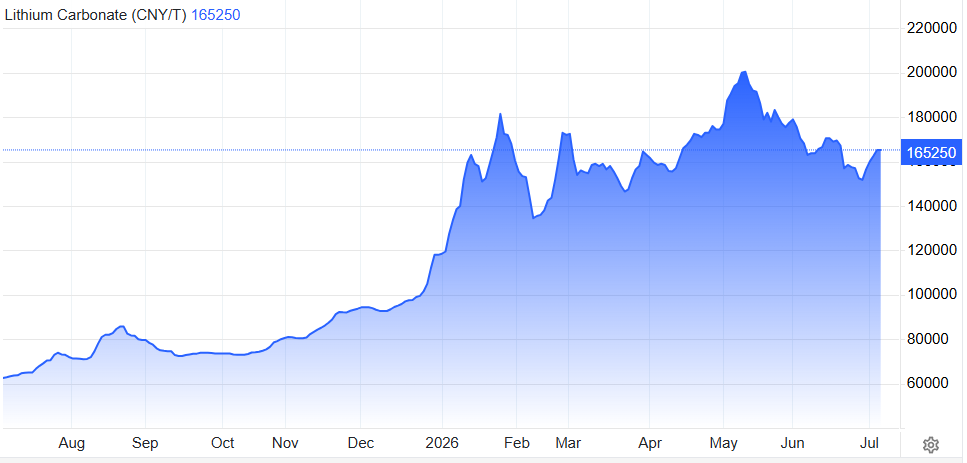
The current state of the market.
This post is not investment advice and not a buy or sell recommendation within the meaning of the German Securities Trading Act (WpHG) — it reflects my personal market observations and opinion only.
The author holds equity positions in lithium companies and is therefore not neutral. Investing in equities carries substantial risk up to and including total loss of the capital invested. Please do your own research or seek qualified advice.
The CATL Jiangxi mine is on the verge of restarting. Its influence on the market is enormous — rumours alone had already pushed lithium futures down — but many observers rate its actual impact as “manageable”. Hopefully the restart is now priced in.
Analysts are divided
As always in the market, the most important driver for price is supply vs. demand — i.e. whether there is a surplus or a deficit of lithium carbonate (LCE).
- Benchmark sees the “CATL mine restart in H2 2026” scenario (which has now materialised) as the single largest swing factor between surplus and deficit for 2026, and now expects an oversupply for 2026. Around this mine there was disagreement not only on the timing of the restart (UBS also expected H2 2026, Wood Mackenzie only in 2027) but also on nameplate capacity and ramp-up speed. Benchmark estimates 62 kt for 2026 (H2), 100 kt LCE in 2027, and 150 kt LCE in 2028. The Mysteel forecast of 45 kt for H2 2026 broadly supports this.
- Others such as Joe Lowry or Dwayne Sparkes are more sceptical, pointing to the generally low ore quality and high project cost, and expect ~25 kt LCE for H2 2026 (Sparkes’ estimate, given before the now-official early restart date).
Many other analysts see both a short-term deficit for H2 2026 and a long-term deficit, and therefore at least price levels acceptable to both producers and customers (~ above USD 20,000/t LCE). The IEA, for example, sees a large gap in all scenarios over the coming years. I would also place Wood Mackenzie on the bull side — across all scenarios they expect demand that current supply plans will not meet.
Across all scenarios, WoodMac reached the same conclusion: lithium remains essential to the energy transition, and current supply plans fall short of future demand.
Arcane Capital also sees a deficit ahead.
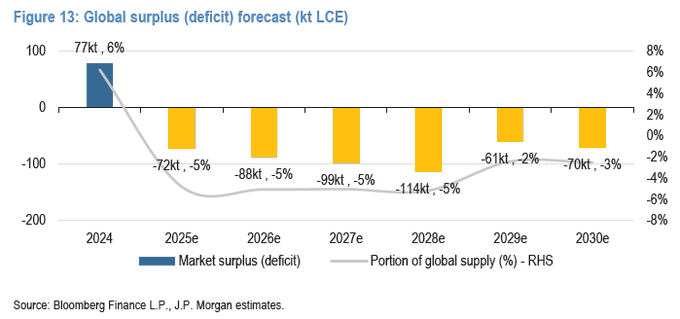
And JP Morgan sees a deficit at least through 2030:
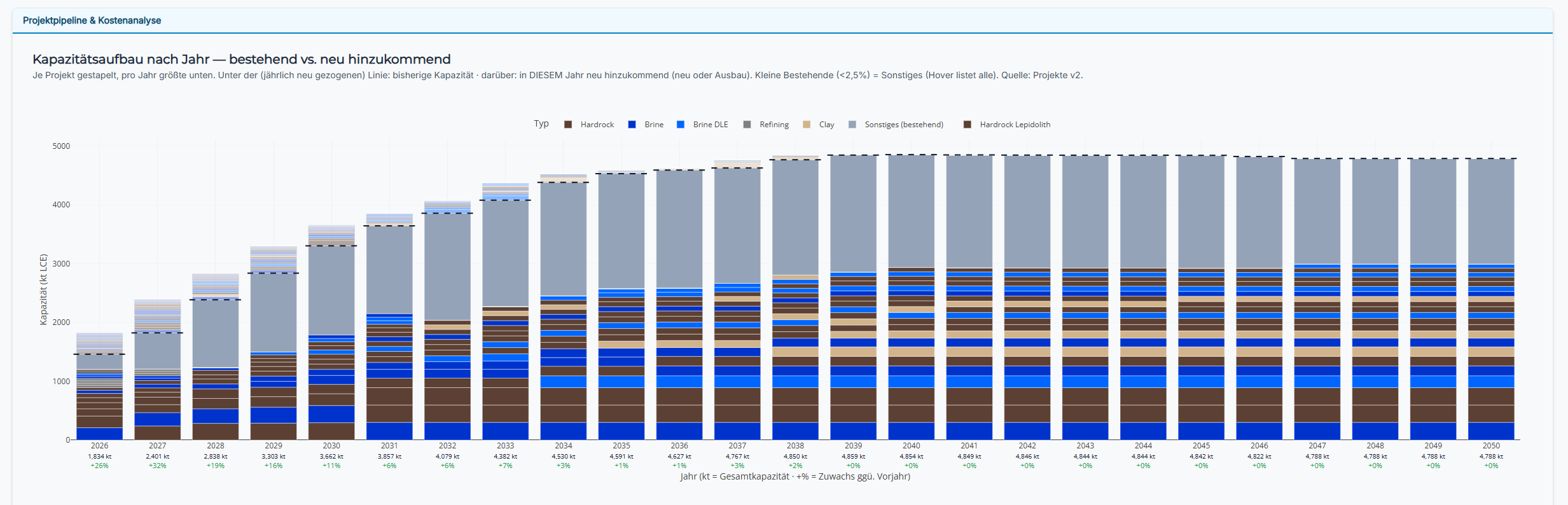
Inside the Lithium Compass (still under development), several analyst supply/demand and price forecasts are plotted. On the supply side, a large number of projects and mines worldwide (already 125) are in the tool’s database and are contrasted with analyst demand forecasts.
A brief bullet-point summary of what to watch on both sides today.
On the supply side
- Problems in Africa
- Persistent gap between announcement and actual ramp-up — complications, delays, etc.
- New Australian mines in 2026 with Core Lithium, MinRes, PLS, Cosco, Zijin Mining (see Compass)
On the demand side
EVs
- Rising growth in key markets (Europe +20% BEV share, even +41% YoY at 33.3% penetration in June 2026; global share moving from 26% to 29–34%)
- China’s domestic EV market is weakening while exports are growing strongly. There are new, smaller subsidy programmes but from 2027 the phase-out of incentives is scheduled. CNEVPOST
- BESS as the second most important driver behind EVs, with very high growth rates. Germany’s future scenarios go from 3 GW in 2026 to 84 GW in 2040
- Heavy trucks: new China target of 40% market share by 2030 (CNEVPOST; +107% YoY)
- Data centres via BESS are another major demand-boom factor
- Oil shock from the ongoing Iran war makes BESS and EVs an ever more attractive substitute
The question is whether this demand can absorb the additional supply coming online.
Indicators for surplus / deficit
- Inventories keep falling and falling
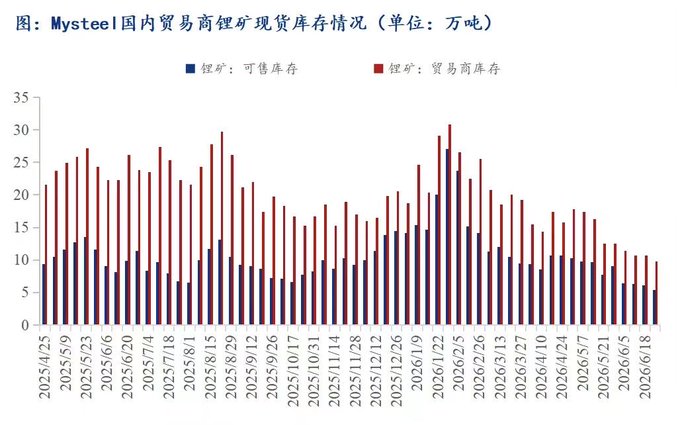
— Source
- CATL is hedging against rising prices with futures
- Demand-side supportive: rising BESS deployment MoM, for example
-
According to a Chinese analyst (author unknown), a new price peak is expected in H2 2026:
The market is highly likely to enter a peak season in the second half of the year. It is almost certain that full-year LFP production and sales will exceed 6.2 million tons.
— Source
Additional key points
From arguably the most important lithium conference:
- Fastmarkets conference verdict (cautiously optimistic)
-
GANFENG sees weakness in FIDs (a bit of a stretch, but this could once again trigger a real bull run)
Among the few upstream lithium resource enterprises that have recently announced expansion plans, the Final Investment Decision (FID) for capacity expansion has been postponed to the end of this year or even next year.
— Source
Missing investment today is missing production capacity tomorrow.
-
The US is starting to build a strategic reserve — symbolically small, possibly a subsidy vehicle for domestic DLE, but a clear signal that lithium is being treated as strategic
- Long term (thinking 2028–2030), sodium-ion batteries take share from the ever-growing pie, especially in BESS. But until then they still need to be scaled by CATL. This will not be the end for lithium.
The US Defense Logistics Agency is starting a five-year lithium carbonate procurement programme. At roughly 16.1 kt LCE in total (of which ~3.6 kt in year one), the volumes are very small and likely serve primarily as a form of state offtake guarantee to support more mature domestic DLE pilot plants. Despite the small size — 3.6 kt is about 0.24% of 2025 supply (~1,500 kt) and will not meaningfully move demand — it is a clear signal of lithium’s strategic classification.
— Source
My take: short to medium term, we’re heading into a good period for the lithium market. Yes, additional capacity is coming online and the lithium price has been rather weak over the past days and weeks — but there are many signs that the demand side is robust and strong and that a reasonable price level above USD 20,000/t LCE can be held. I prefer projects that (a) already produce and (b) sit in the 1st–2nd cost quartile — especially in South America.